Constructivism in Museums (A short reading response)
“The ancestral style of museum reflects a positivist view of the world as entirely ordered and rule governed… the constructivist view emphasizes the active and imaginative dimensions of learning and discovery… The contrast of these two views is between “top-down” and “bottom-up”. (Russel, 1994)
I like the way these two views are contrasted and explained in this article, however I think the application of this classification becomes slightly more problematic and difficult to assign exhibitions to either view. However, it may be possible to place exhibitions on a spectrum between the two (which may be oversimplifying the issue, as we’ll see presently).
“…’hands-on’ is not an end in itself, but a means to and end: activity and perception require the individual to apply interpretative frameworks in order to make sense of the experiences which museums provide.” (Russel, 1994)
This is an important point and something to keep in mind throughout the design process for any learning experience. While visitors or learners can be engaged to some extent with a designed activity, there is no guarantee that they will actually learn from the experience. For example, visitors could be engaged with a hands on coloring activity at a museum, but they might be coloring a picture of indigenous masks to look like their favorite Star Wars characters. While they are engaged, it is likely they are not engaged with the target content. (Whether that is a problem depends on the museum and the overarching goals.) As Russel (1994) reiterates later, “the doing must support the thinking.”
Hein (1995) takes Russel’s top-down and bottom-up views of museums a step further by adding another axis.
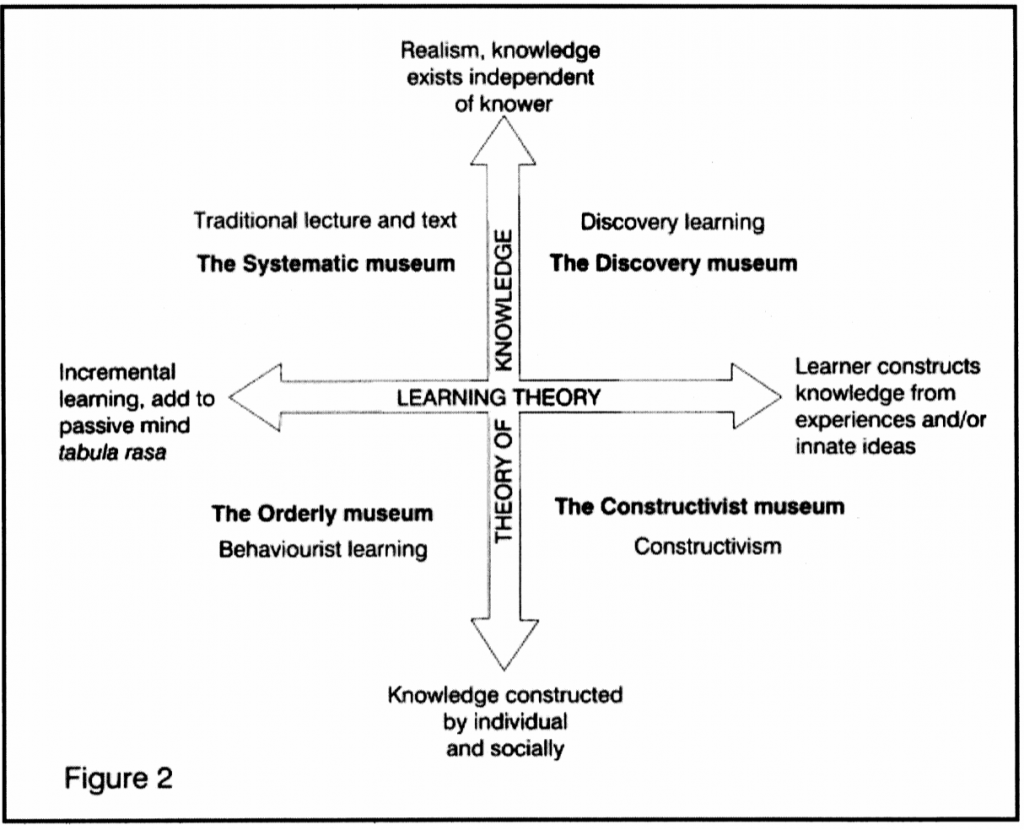
From Hein, 1995.
Hein creates a spectrum along an axis corresponding to a theory of knowledge and another which corresponds to the theory of learning. Placing museums and exhibits on this matrix is an interesting activity. For example, Dinos Among Us, a temporary exhibit at the American Museum of Natural History, has elements of all quadrants, except perhaps “The orderly museum.” There is a clear educational goal to the exhibit: birds are the descendants of dinosaurs. This is a point made upon entering the exhibit, but once visitors move beyond the initial area, the design lends itself more to discovery by allowing visitors to create their own path through a variety of different stations which provide arguments and examples as to why this theory is correct. However, at the end of the exhibit visitors are again brought onto a single path with a video and digital interactive to reinforce points about the skeletal structure of flying dinosaurs.
Looking at the Metropolitan Museum of Art at first glance seems to provide the ultimate constructivist museum. There is very little scaffolding and visitors are free to wander wherever. A visitor who looks at Chinese decorative arts and a photography exhibit is going to have a very different experience and construction than someone whose goal is to only explore French interior decoration. This of course highlights the immense variety of visitors who come into a museum, but it misses the fact that museum is systematic, in a way, by dividing each section into subjects and categories developed by the field of art history. That system teaches us that ancient Persian statuary, Japanese armor, and landscapes from the Hudson school do not belong together. While a visitor can have almost any sort of experience and construct their own knowledge of a genre, those genres are delineated by the museum and it may be difficult to break those categories.
References
Hein, G. E. (1995). The constructivist museum. Journal for Education in Museums, 16, 21-23.
Russel, T. (1994). The enquiring visitor: Usable learning theory for museum contexts. Journal for Education in Museums, 15
0 Comments